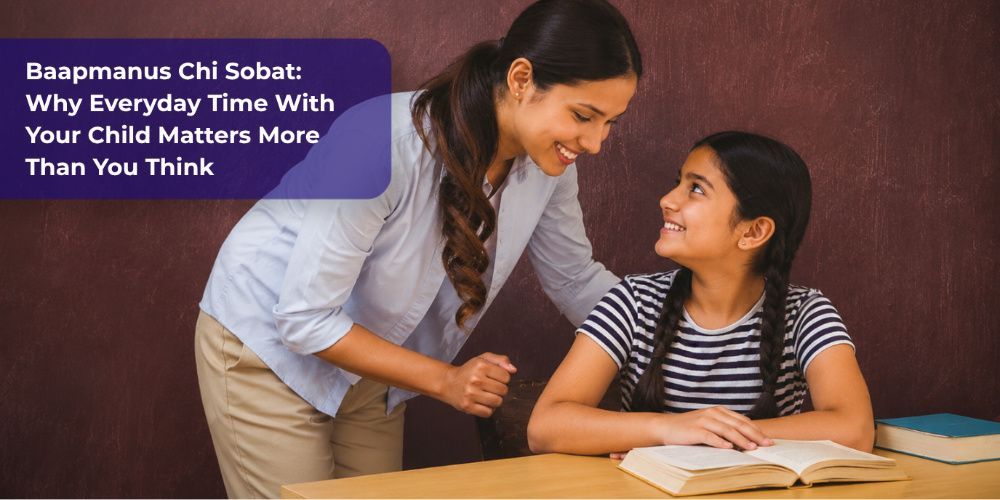
Baapmanus Chi Sobat: Why Everyday Time With Your Child Matters More

- Admin
- 20 May 2026
Suresh works in his field from before sunrise. He arrives home to find his son, Rohan, half asleep over a textbook and already fed dinner. Sometimes they dont speak at all. Most nights, not even that. Suresh tells himself hes doing this for Rohan. The ground. The labor. The sacrifices. Its all for his boys future.
What Suresh doesnt realize is that Rohan has given up on education. Not because he is not wise. But because somewhere inside, a seven-year-old thought he wasnt important enough to be acknowledged.
This blog is about the parenting suggestions that are often missing in the rural India Marathi conversations that a fathers presence, a mothers attention, and the regular moments between parent and child are more powerful than any tuition class, gift,t or financial sacrifice.
Presence Costs Nothing, Not Even a Day Off
When people talk of spending quality time with children, many parents in rural and semi-urban Maharashtra automatically believe that it is for someone else. Someone having a steady job, a regular schedule, and the luxury of evenings free of fieldwork or shop-closing rituals.
But not all families have the same experience of spending time with children in India, and they dont have to. Presence is not a program. Its not a weekend tri or a planned-out activity. Its the ten minutes you spend walking your child to the bus stop, not looking at your phone. Its sitting down with them at dinner and asking one real question. It is observing when they stop talking.
The families that raise secure, confident children are the ones with the greatest money or the most time. These are the ones when the child knows they are being viewed without being told.
The Quiet Strength of Eating Together and Evening Conversations
Studies on the value of family bonding in India invariably highlight one basic habit: families that eat together often produce children with better emotional regulation, greater academic results, and a lower likelihood of dropping out early. Not that the meal is special. Because the table is where a child learns that their voice matters.
In many Marathwada houses, a communal dinner is already a tradition. The chance is there already. What takes it from a chore to a bonding experience is something small: asking a question and actually waiting for the answer. Not Did you study? but What happened at school today that you did not see coming? The first shuts a door. The latter begins a single.
Fathers Dont Know How Much They Matter
In rural Maharashtra, the emotional function of the father is often underrated, even by the fathers themselves. The expectation, handed down through generations, is that a guy provides. That protection is being done. That love is not whining.
And yet the evidence from emotional parenting in Maharashtra is clear: a fathers emotional engagement, his willingness to listen without judgment, to validate a childs feelings, to be present not only as a provider but as a human being, impacts a childs confidence and behaviour in a way that no other factor can match.
Suresh did not have to be another man. He needed to understand that Rohan didnt need a better future as much as he wanted his father in the now.
Keeping in Touch During the Seasons That Pull You Apart
Harvest season. Exam season. Money hardship. Family health problem. There will always be something to alienate you. The parenting recommendations that Marathi families from rural India commonly deal with are rarely about routine days. Theyre about the tough times, when a parent is running on fumes and a youngster is silently soaking up the tension in the house.
It doesnt mean extended chats to stay emotionally engaged during these times. A hand on a shoulder. I know things are rough right now, and I can tell that you are working very hard. That is enough to tell a youngster that when the world around them is in doubt, they are not invisible.
Simple questions that unlock doors
Most youngsters will not talk unless they are prompted in a way that is secure to them. Some queries that actually work:
What made you chuckle today?
Had there been anything that seemed unjust?
Is there anything youre worried about that you havent told anyone?
For these questions, the youngster has to do nothing and report nothing. They are welcoming. And if they are asked repeatedly over days and weeks, they create a channel of honest communication that will last through adolescence and into adulthood.
The Impact of Presence on a Childs Behaviour and School Life
The link between parents and children in India and school outcomes is not a theory. When children feel seen at home, they are less inclined to act out at school for attention. They are more likely to complete their school, less likely to drop out under social or financial pressure, and much more prepared to handle peer influence.
Child behaviour improvement advice in India is typically on what to fix. It is more powerful to develop a relationship in which rectification is possible. A youngster who trusts his parent will listen. Ignore a child, and he will find an audience.
Marathwada: Presence, and when everything changed
After a meeting with his daughters school teacher, Ramkrishna, a farmer from a village near Latur, made one modest modification. He chose to walk her to school three mornings a week. No big design. No fresh investment. Just three times a week for twenty minutes.
Within a school term, she improved her attendance. Her teacher observed her taking part in class. Ramkrishna discovered something curious. He began to look forward to those twenty minutes more than to any other part of his day.
Such anecdotes have been chronicled by the Latur parental education projects around the region. The pattern continues. When parents turn up, kids show up as well.
What Every Parent Already Possesses?
Parenting advice that rural Indian Marathi families need is rarely resourceful. Its about reclaiming what we already have: a shared meal, a brief walk, a question given with care, a moment of eye contact that says, You matter to me.
Eventually, Rohan informed a teacher that he was struggling. The teacher called out Suresh. What followed was no great turning point. It was Tuesday night, and Suresh sat at the table with his kid. For a long time,e he said nothing. Then he said, What is it you really like to do? Rohan looked up with a start. Then he began to speak. And he did not stop for an hour.
MIT World Peace School, Latur, believes that a childs maturation begins not in the classroom, but in the home. This blog is an appeal to each parent in Marathwada and beyond, to understand that the most essential thing that you can give your child is not a better school, a better phone, or a higher mark. Youre it. Present. Listen. There.