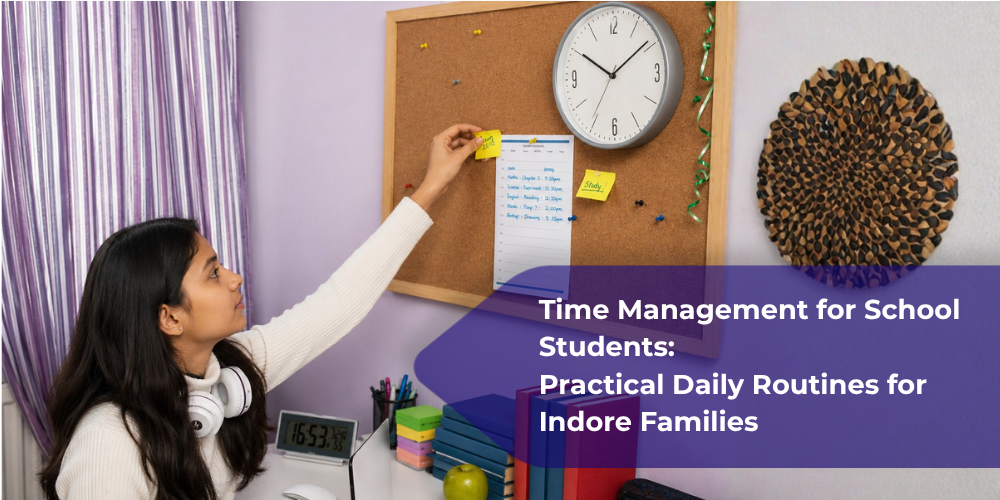
Time Management for School Students: Practical Daily Routines for Indore Families

- Admin
- 24 June 2026
Good intentions. Every night, 13-year-old Arjun arrives home from school. He has homework to do, a test to revise for, a cricket coaching session to attend, and yet still finds some time to himself before going to bed. But somehow, at the end of the day, crucial jobs are left undone, stress levels are up, and sleep is pushed back.
If this sounds familiar, you are not the only family. Many students struggle not because they lack aptitude but because they lack organisation. The good news is that you can make even the craziest schedule work with careful planning.
This article will look at practical tactics for time management for school students, realistic daily routines, typical mistakes that waste time, and how parents can teach youngsters to be more independent and organised.
Why 'Time Management' Doesn't Work for Kids (And What Does)
Adults typically urge kids to "manage your time better." Of course, this is good advice, but generally too ambiguous to be of any help.
Children are still developing their planning, prioritising, and decision-making skills. Often expecting children to manage time without a system leads to misunderstanding.
What works better is to give structure. Well-defined routines, visible calendars, and regular habits let students know precisely what has to happen and when.
How kids do well in school with their time has less to do with motivation and more to do with making good choices simpler by developing processes.
Indore Reality: Traffic, Tuitions, Hobby Class, Dinner, Sleep
Many students in Indore juggle a lot of duties every day.
A weekday could go like this:
- Education
- Homework
- Tuition classes
- Sports coaching.
- Hobby or Music Lessons
- Family time
- Sufficient sleep
Add in travel time and traffic, and schedules can get rather overwhelming pretty fast.
This is why families want practical routines, not idealised timetables that seem fine on paper but are impossible to adhere to consistently.
How To Make a Realistic Daily Routine (With Template Examples)
Let's go back to Arjun. When his family set up a schedule, he felt less worried and was able to get more done, even without studying longer.
Morning Routine 6:00 AM - 7:30 AM
A calm morning sets the tone for the day.
Here is a sample morning routine:
- 6:00 AM: Wake up & Freshen up
- 6:15 a.m. Stretching or Light Exercise
- 6:30 a.m. Breakfast
- 6:50 AM: Quick overview of the day's tasks
- 7:15 a.m. - Go to school
This kind of daily schedule for kids in India helps kids to start the day with clarity instead of racing through every activity.
After School Hours: 3:30 PM - 6:30 PM
Children need time to recover after school.
A possible balanced schedule might be:
- 3:30 PM: Come home and eat a snack
- 4:00 PM: Play outside or take it easy
- 5:00 PM Tuition or Hobby courses
- 6:30 PM - arrive home
This technique assists in balancing study and play, which is so vital to academic success and general welfare. Structured options like sports, music, and hobby pursuits are a big part of our Co-Scholastic Activities.
Evening Study: 6:30 PM to 8:30 PM
Focus on concentrated learning throughout this period.
Students can split study time into:
- Homework completed
- Revised Classroom Lessons
- Preparation for forthcoming assessments
Having a well-planned study timetable for school kids reduces the tendency to procrastinate and panic at the last minute.
Wind-down Routine: 9:00 p.m. to 10:00 p.m.
Many students do not know the value of evening routines.
A healthy routine could look like:
- Family supper
- Preparing the school bag for the following day
- reading and relaxation activities
- Bedtime 10:00 PM
One of the most disregarded factors of good time management for school children is the quality of sleep. Supporting this kind of physical and emotional balance is central to our Wellness Center.
Students Should Steal Time-Blocking from the Business World
Many professionals keep productive using the method of time-blocking, and students can also profit from the same technique.
Time-blocking is just designating certain activities to certain time slots.
For instance:
- 6:30 PM - 7:00 PM Practice Math
- 7.00 pm - 7.30 pm: Science revision.
- 7:30 PM - 8:00 PM: Finish homework
The students do not decide what to do every few minutes but follow a prearranged strategy.
This strategy is very useful in making a timetable for CBSE students as it helps in reducing decision fatigue and improving uniformity. Our Middle Years programme builds these structured study habits into everyday learning.
The 'Two-List' System: Must-Do Today or Nice-To-Do Today
Students often make to-do lists that are not realistic and then feel disheartened when they cannot get everything done.
The preferred way is to maintain two lists.
The first one has critical duties that are to be done today.
The second consists of optional tasks that may be performed if time allows.
This simple technique teaches kids to prioritise and reinforces time management without putting undue strain on them.
How to Differentiate Exam-Time and Normal-Day Schedules
A common mistake is to use the same regimen throughout the year.
The normal school day should give priority to schoolwork, revision, hobbies, and recreation.
During test periods, schedules need to adjust towards:
- Other blocks of revision
- Resubmission papers
- Less time for entertainment
- More targeted subject review
Flexibility is the key. A schedule should be flexible to fit the demands of school, not rigid.
Common Time Wasters Indian Students Get Involved In
Students wasting time using useless habits over and over again can ruin the best schedule in the world.
Long Unstructured "Study Sessions" That Turn Into Doom-Scrolling
Many students sit at a desk for two hours, yet only a small percentage of that time is spent studying.
Without clear goals, distractions quickly take control.
Re-Reading Instead of Practice
Re-reading the same notes over and over again will give you a false sense of learning.
Practicing questions, solving difficulties, and testing recollection usually give better outcomes.
Getting Ready to Study, Not Studying
Organising stationery, arranging books, and cleaning the study table are ways of procrastinating.
Preparation is good, but once you have the things prepared, you want to start learning.
Tools that help: diaries, planners, and free student apps
It doesn't cost students a fortune to stay organised.
Simple tools are often the best:
- Planners daily
- Students diaries
- Calendars on the wall
- Reminder applications
- Online Task Managers
These tools help school students maintain a consistent study schedule while encouraging independence and responsibility.
When (and How) Parents Should Back Off
Children may need help in establishing routines at first. But as students learn responsibility, parents should relax their supervision.
Instead of always telling kids what to do, ask questions such as:
- What are you doing today?
- What is your priority task?
- How will you manage your revision this week?
This approach encourages ownership while preserving confidence.
Ultimately, successful time management for school students is about helping children build lifelong organisational skills rather than simply completing today's homework.
Conclusion
Good time management is not about filling every minute with work. It is about creating routines that support learning, rest, hobbies, and personal growth. This guide offers practical strategies that help students stay organised, reduce stress, and develop healthier habits. With the right structure and parental support, children can learn to manage their responsibilities confidently while maintaining a balanced and fulfilling school life. To see how our campus supports balanced, well-rounded learning, book a school tour.