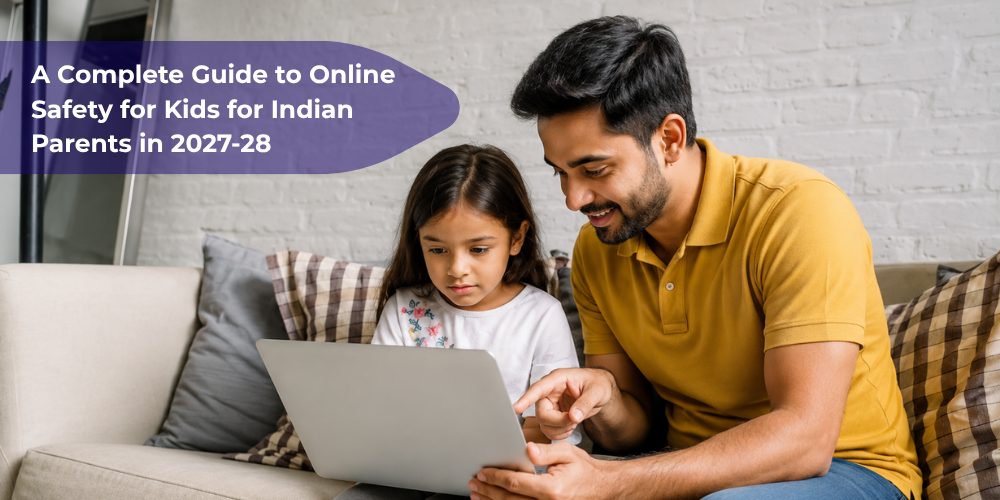
A Complete Guide to Online Safety for Kids for Indian Parents in 2027-28

- Admin
- 20 August 2026
Fred Rogers reportedly stated, To me anyone who helps a child in his life is a hero. As Nelson Mandela said in another way: Safety and security dont just happen. Both notions are core to raising a child in a connected home today. Online safety is not luck. Its something parents build, one setting, one conversation at a time.
In this blog, we will discuss what internet threats look like, how to set up true protection on your kids devices, the family interactions that keep them honest with you, and the legal procedures every Indian parent should know. By the conclusion youll have a clear, practical starting point for tonight, not simply a list of cautions.
What Online Threats Actually Are
Think about the time your youngster spends online after school. A WhatsApp group with classmates, a few movies, a game with buddies. That time is mostly benign. However, here is also where three actual dangers lurk: harassment in group conversations, grooming via gaming platforms where a stranger gradually gains trust through gifts and compliments, and scam messages claiming to be news of a prize or bogus scholarship applications requesting personal details.
Grooming is seldom startling at first. It grows gently, with little kindnesses and intimate conversations that drift away from the public discourse. That turn toward concealment is the warning sign most often missed by parents. Scams also share a similar pattern of disguise. If you get a text message asking your child to provide an OTP or Aadhaar details for a free prize, it is not a school notice. Its a script designed to appear official.
Exposure to inappropriate content, however, is generally accidental, through autoplay videos or search results rather than through intentional searching. It influences the way parents respond. The goal is not to cause panic. To see the mechanism, and to bridge the gap.
Setting Real Protection on Every Device
The devices themselves need boundaries before any conversation happens. Google Family Link is the most useful starting point for Android phones, since it enables parents manage app installs, screen time, and content filters from their own phone. That typically means instead of looking through generic menus, you go into Settings, then Digital Wellbeing, then Parental Controls on your childs device.
If you have more than one device, its worth putting up router-level filtering once. It filters specific types of websites at the WiFi level, before the content even gets to a phone, tablet or smart TV. That one step is universal to every device in your house, not just one.
Physical location is important too. Leaving devices plugged in to charge overnight in a bedroom can promote unsupervised use. Its a basic, low-friction guideline that performs most of the job itself: keep them in a shared location (like the living room).
Passwords demand equal care. Parents should know account passwords for children under 13, not to spy, but to help with recovery if an account is closed or compromised. Indian parents often miss out on WhatsApps who can add me to groups feature, which directly curbs unwanted interaction through school and neighbourhood groups.
Communicating With Your Child Without Fear or Preaching
Now none of this works without discussion. Kids who are terrified of getting in trouble tend to hide problems rather than disclose them. So instead of talking about the dangers online ask your child what games they play, and who they talk to while playing. Curiosity opens doors that lectures shut.
Admitting that you as a parent are still understanding the apps your child uses might also change the tone of these chats. It asks your child to teach you something, and that little role reversal creates trust. That trust is why a youngster comes to you first, when anything feels wrong online, instead of hiding it.
A basic family device contract helps, too. This doesnt have to be formal. It needs to include what apps are authorised, when displays go off, and what happens if something uncomfortable pops up online. In any such agreement, the most beneficial regulation is usually the one that protects sleep: no screens for an hour before bed, as late-night scrolling stymies the bodys natural wind-down.
Know your legal parental rights
If something does go wrong, parents have genuine tools under Indian law. The IT Act 2000 and POCSO Act cover charges from privacy violation to sexual exploitation of a kid and cases under POCSO are prioritised by law enforcement. If your child is under serious threat online, the steps are simple. Take screenshots of everything with timestamps visible, take down the URLs and usernames involved and report the event on the National Cyber Crime Reporting Portal at cybercrime.gov.in or at your nearest cyber cell.
For anything urgent, a kid in distress can call CHILDLINE Indias helpline, 1098, at any hour of the day. Save it in your phone today, before you ever need it.
Embrace Open Discussion of Internet Issues
It is also easier to maintain online safety if it is handled as a part of normal family life, rather than a particular topic that only occurs when something has gone wrong. You can have a simple weekly check-in when your child informs you about a new app they are using, someone they met online, or anything that made them uncomfortable. You dont have to read every communication or have access to every account. The idea is to make asking for aid normal. Kids who believe they have the freedom to talk about an internet mistake without being instantly criticised are significantly more inclined to come to you when they really need help.
What You Get From This Guide
Real online protection is neither a single tool or a single conversation. Its the device settings you put up this week, the conversation you start today, and the legal knowledge you maintain in your back pocket, all functioning together. Most families will set one of these up and leave the other two open.
Choose the item you havent done yet and start there. That one step made today will close more of the gap than all the concern in the world ever could.
At WPS Indore, we believe that creating safe and confident digital citizens is a partnership between school and home. If you want help setting up parental controls or starting these talks with your child, our team is here to help.